

Key highlights:
- Organisations that turn data into intelligence, intelligence into decisions, and decisions into real-time action are best positioned to succeed.
- Multi-dimensional, interconnected data is essential for AI-driven automation to unlock genuine, high-value results.
-
Real bottom-line impact is unlikely to come from applying AI to old, broken workflows. Transformational value happens when we redesign how work gets done, unify our data, and empower AI to take targeted, controlled action.
Equifax Australia brought together senior executives across retail and commercial lending at the Equifax Australia Innovation Day 2026 to explore how AI is actively reshaping decisioning, risk management and the customer experience.
Alongside demonstrations of new product developments from Equifax experts across Australia and the United States, delegates engaged in insightful discussions around the immediate opportunities - and key hurdles - for AI-led innovation.
How do we turn AI innovation into measurable impact?
_0.jpg)
Melanie Cochrane, CEO and Group Managing Director of Equifax A/NZ opened the morning by framing a shared industry challenge: growing revenue, accelerating decisions and delivering seamless digital experiences while navigating credit risk, tightening margins, sophisticated fraud and expanding regulatory demands.
While extensive AI experimentation has yielded pockets of brilliance, organisations now face the task of scaling these initiatives to deliver a return on investment.
Melanie highlighted that AI automation goes beyond cutting costs and saving time: “How do you reimagine and transform the customer experience? How do you approve a genuine customer instantly while stopping automated fraud or making decisions faster without compromising risk or compliance?”
It’s not the models alone that will enable this shift. Creating value will come from having trusted intelligence informing and underpinning the technology.
“We’re directing our innovation towards giving you a complete, clear picture of the people and businesses behind the data - enabling decisions that deliver the best outcomes, the best customer experience, and ultimately drive growth,” said Melanie.
“Trust is at the heart of what we do. It’s the verifiable data sources and the responsible use that becomes absolutely critical to success.”
Key takeaway:
Scaling AI effectively relies on trusted intelligence. By pairing verifiable data with intelligent automation, financial institutions can be better positioned to execute confident, high-speed decisions that enhance the customer experience without compromising risk controls.
Using AI to balance speed and risk starts with customer needs
_0.jpg)
Raghu Kulkarni, Chief AI Officer at Equifax, presented the forward-looking AI roadmap for Equifax.
Enterprises face twin pressures as fraud and credit risk accelerate simultaneously. For example, a 2100% surge in AI deepfakes is driving a sharp rise in fraudulent credit applications. “Fighting AI with AI is becoming a core business imperative,” noted Raghu.
Tackling this requires a multi-layered information architecture working in sync to deliver stronger signals and actionable intelligence across every stage of the credit lifecycle. This principle underpins the ‘Equifax Innovation Flywheel’. Grounded in the client’s goals and risk appetite, this architecture leverages Equifax Ignite AI Advisor to measure, diagnose, build and optimise - before deploying into production and feeding real-time results back into the loop.
Raghu demonstrated how strategy architecture using explainable algorithms and differentiated, AI-ready data can uncover quality borrowers that traditional, less granular methods miss, with a 16.3% improved outcome from a major US Auto portfolio use case*.
Raghu also cautioned against over-relying on generalist frontier models: “Without context, frontier models can derail quickly. If you try to give an unstructured data set to these models, they will likely behave like a 5 year old!. Next year, the conversation won’t be about public LLM releases - it will potentially be about deploying your institution’s own proprietary foundation models.”
“At Equifax, human-in-the-loop oversight is integral to our AI innovation. Our roadmap is built on a strong semantic layer and specialised capabilities to create trusted systems that enable organisations to make confident decisions”, Raghu added.
Key takeaway:
AI can help financial institutions balance speed and safety by tailoring decisions to their exact risk appetite, uncovering approval opportunities that strengthen overall portfolio performance.
What does trust look like when the world moves in real time?
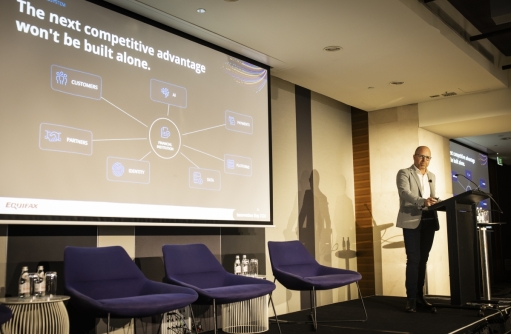
Brad Weber, Chief Product Officer at Equifax A/NZ, highlighted trust as the core foundation for modern innovation.
“For most of the history of financial services, trust has been established by looking backwards. But looking backwards is no longer enough when customers no longer live in snapshots. Money moves in real time. Identity moves across platforms. Fraud evolves in real time. Customer circumstances change fast. Above all, customers expect financial experiences to be both instantaneous and safe,” Brad stated.
Success requires moving beyond data collection to translating data into real-time decisioning intelligence.
“The opportunity isn’t just automating decisions - it’s rethinking how we make them. As systems become more automated, enterprise trust becomes more important, not less. And I mean trust in the broader sense: resilience, security, responsible use of data, regulatory confidence and, of course, ultimately customer confidence,” Brad continued.
Industry leaders are advancing from hindsight to predictive foresight, connecting internal and external data faster across platforms and partners to understand customers more completely. This unlocks faster, smarter decision-making with measurable confidence.
This operational shift transitions institutions from point-in-time checks to continuous trust models that monitor risk dynamically. “This changes trust from being the gateway of the customer journey to trust being something that can live continuously through the customer relationship. Risk doesn’t arrive once a year, fraud doesn’t wait for the next review, and intelligence certainly isn’t standing still,” concluded Brad.
Key takeaway:
To power continuous trust in real time, Equifax pairs trusted local intelligence with access to Dun & Bradstreet’s global business data - giving A/NZ organisations the comprehensive insight needed to manage risk, unlock growth, and trade with confidence locally and internationally.
How verified identities help customers swipe left on scammers
_0.jpg)
A panel featuring Drew Beresford (Head of Solutions), Riki Gardner (Senior Product Owner - Scams), and Disha Goyal (Senior Product Owner - Digital Identity) explored how combining verified digital identities with fraud data networks helps combat sophisticated scam activity.
The regulatory landscape has evolved with the 2024 Digital ID Act, establishing a framework to extend government digital ID to private sector providers through solutions like Equifax myVerified Pass. This allows individuals to verify their identity securely without continually sharing physical documents, retaining full control over their personal information.
Equifax Verified ID (myVerified Pass) helps enable secure, remote customer onboarding while reducing identity verification (IDV) times from hours to minutes for returning users, simultaneously reducing business liability around Personally Identifiable Information (PII).
However identity verification is only part of the solution. “Digital ID can verify that a person is real, but it can’t stop a verified person from committing a scam. That verified badge doesn’t necessarily guarantee good intentions,” noted Drew. “When an actor uses fake urgency to trick your customers, you need to swipe left and fast.”
The panel illustrated this using a dating app scenario where two verified profiles interacted. Despite passing ID verification, one user initiated class romance scam tactics - using artificial urgency and pressuring the target to move off-platform.
Equifax Scam Detect integrates with verified identities to “as the ultimate power couple” to defend against scam tactics, said Drew. A live demonstration showed how Scam Detect flags and intercepts scam attempts in real time before financial loss occurs. It uses live intelligence-sharing and a real-time Scam Likelihood Score driven by AI and linguistic markers to screen, ingest and make decisions on scam risks directly within existing workflows.
Currently in pilot, Scam Detect builds on the Known Fraud Exchange framework established by Equifax, driving cross-industry collaboration to tackle fraud collectively.
Key takeaway:
Pairing identity verification with proactive scam detection provides guardrails designed to help mitigate losses, support regulatory obligations, and protect customer trust without sacrificing privacy.
Cutting credit processes from months to hours
_0.jpg)
Greg Kwiatkowski (VP AI Innovation Architect, Equifax US) and Stuart Musgrave (Head of Advisory, Equifax A/NZ) demonstrated how Equifax IQ leverages AI to help streamline credit workflows and navigate changing market conditions.
Traditional credit lifecycle processes rely on rigid logic and manual overhead, making them too slow for modern market demands. Equifax IQ solves this by simplifying data extraction and analysis to generate actionable credit policy recommendations.
“Many lenders go months or years without updating credit policies due to system friction and manual workloads. Equifax IQ breaks this operational bottleneck by introducing targeted AI efficiency,” said Greg.
Greg demonstrated how Equifax evaluates key metrics - such as booking volumes, approval rates, loss rates and risk adjusted lift - using rapid modelling across signal variations to refine credit policy.
“We can condense policy review cycles from months down to hours or days. Deployed into your organisation, this capability allows you to run a lot more frequent champion challenger tests, helping ensure credit policies stay responsive, competitive, and aligned with market shifts,” Greg added.
Key takeaway:
Innovations like Equifax IQ harness AI to help automate processes and optimise logic, enabling real-time credit decisioning across the lending lifecycle.
Bridging speed and risk in commercial customer onboarding
_1_0.jpg)
Brad Walters (General Manager, Commercial, Equifax A/NZ) and Tomas Souter (Sales Leader, Commercial, Equifax A/NZ) shared strategies to streamline commercial onboarding while satisfying Know Your Business (KYB) requirements.
With updated Anti-Money Laundering and Counter-Terrorism Financing (AML/CTF) obligations in Australia, commercial lenders need solutions that balance speed and simplicity with revenue growth and robust risk control. “Connected network intelligence allows financial institutions to fast-track commercial onboarding without cutting any corners on risk,” said Brad.
This approach counters complex corporate structures designed to hide risks like phoenix activity, credit contagion and money laundering. Relying solely on basic ASIC lookups or manual filings leaves critical blind spots.
“To really combat credit risk, fraud and financial crime, you have to look deeper and pierce the corporate veil,” Brad emphasised.
The session featured a demonstration of ‘trust discovery’ - using digital extraction on unstructured documents to rapidly identify key decision-makers. This was followed by a preview of next-generation KYB network intelligence and agentic AI workflows designed to help handle commercial onboarding end-to-end.
Replacing manual document reviews with automated network intelligence could help significantly reduce commercial onboarding turnaround times. This includes surfacing Ultimate Beneficial Owners and complex control structures, resolves edge cases via conversational AI, and maintains an immutable source-linked audit trail.
“Streamlining and automating routine steps lowers cycle times - which leads to happier customers - backed by a bulletproof audit trail. Teams no longer need to slow down operations out of fear of what’s around the next bend; they can move forward with confidence,” Brad said.
Key takeaway:
AML/CTF solutions from Equifax deliver connected network intelligence, building a clear view of customer relationships, ownership structures, and behaviour patterns.
Customer hardship vs. fraud: Spotting financial crime with AI
_0.jpg)
Dilip Singh (VP, Head of Global ID and Fraud COE, Equifax), Warren du Preeze (AI Consultant, Equifax A/NZ) and Jason Jeffers (Head of Customer Decision Science, Equifax A/NZ) unpacked strategies to distinguish genuine financial hardship from intentional fraud.
Historically, fraud is identified after the fact as credit losses occur. Common threats include:
-
Synthetic identities: While low in volume, synthetic identity fraud can drive severe portfolio damage, with average exposure at default (EAD) of $645,000^ per occurrence
-
Credit abuse: High-scoring applicants with no intent to pay, with $179,094^^ EAD per account in losses via rapid stacking of loan products
-
Loan stacking: Borrowers securing multiple credit lines across lenders within a short period - a pattern that can mimic genuine financial hardship if evaluated in isolation.
Data analysis by Equifax across millions of credit lines demonstrates the cascading impact of unmonitored loan stacking. In one tracked example, an account profile expanded from 6 good accounts to 20 accounts across 13 financial institutions in 7 months. By month 17, 50% of those accounts defaulted, resulting in $136,000 in losses across 26 institutions. Unchecked at 22 months, losses reached $723,000 with a 91% default rate.
Detecting these risks early requires shifting from point-in-time checks to temporal analysis
“We’ve moved from point-in-time snapshots to motion pictures,” explained Dilip. Machine learning models process up to 13 months of time-indexed credit data per individual, recognising complex behavioural signatures that traditional static models miss.
Real-time monitoring can help identify emerging risk early and uncover hidden synthetic exposure often misclassified as bad debt. “Combining training data across multiple fraud signals delivered a 35% lift in predictive power across monitored consumer credit portfolios,” noted Dilip.
Key takeaway:
Machine learning unites rich data sources to move beyond static reporting, using predictive analytics to protect portfolios against fraud and systemic abuse.
Bottom-line impact won’t come from applying AI to broken processes
_0.jpg)
The day concluded with a panel session featuring Kari Mastropasqua (Chief Decision Intelligence Officer, Equifax A/NZ) as host and Melanie Cochrane (Managing Director, Equifax A/NZ), Wayne Williamson (CISO, Equifax A/NZ) and Angela Di Rago (General Counsel, Equifax A/NZ) discussing how to move AI from experimentation to enterprise value.
“Real bottom-line impact won’t come from throwing AI onto broken things,” stated Kari. “Value is generated from how we redesign processes, unify data, and empower AI to take useful and controlled action.”
Achieving scale requires rethinking core operations rather than layering technology on top of legacy structures.
“Sometimes it’s too hard to fix a process - and you have to reimagine it entirely. This perspective shapes how we approach our service model blueprints and how we think about end-to-end processes - rather than layering a legacy process on a legacy process,” said Mel.
Trust remains central to scaling AI adoption, notes Kari. “This is a pretty big piece to the puzzle, whether that’s the trust of your employees, the trust of what the algorithms are doing, or the trust of what your agents are doing with other agents.”
While AI accelerates execution, robust governance remains essential. “Maybe we don’t ease the friction. Maybe we welcome it in and give it a space at our table,” suggested Angela. This means making governance part of the conversation from the start and using those conversations as part of the learning, to help find the right balance between speed and risk.
This deliberate approach helps mitigate security risks, ensuring automation doesn’t create vulnerabilities for high-volume attacks.
Wayne used a self-driving car analogy to describe the shift: “Using AI today is like adaptive cruise control - you’re still behind the steering wheel and can slam on the brakes. As autonomous capabilities advance, operations will feel more like rising in the back of an autonomous vehicle, where governance and controls ensure you reach your destination safely.”
Key takeaway:
Successful AI implementation requires a holistic strategy across processes, trust, and security - not just technology deployment alone.
The AI innovation, trusted intelligence and expertise to drive operational impact.

Book an appointment with our team to discover how Equifax can help solve your business challenges and leverage AI innovation to deliver high-impact value.
Further reading: How to Add AI Agents to Workflows Built for Humans
*Based on an internal Equifax US case study (2025/26) on a specific Auto portfolio. Results are indicative and may vary based on individual portfolio parameters and risk profiles.
^Sourced from Equifax Australia Bureau data
^^As above
The information in this document is current as of September 2026 and is for general informational purposes only. It does not constitute legal, financial, or professional advice. While Equifax uses reasonable efforts to ensure the material's accuracy, we make no warranties regarding its completeness or currency. Users should independently verify this information and seek tailored professional advice before relying on it for business decisions.
This collateral may contain forward-looking statements regarding future product developments or business performance. These statements are based on current expectations and may involve inherent risks and uncertainties. Actual results may differ materially from those expressed or implied.
Copyright © 2026 Equifax Australia Information Services and Solutions Pty Ltd. All rights reserved. ABN 26 000 602 862.