
Although insolvencies have recently stabilised, they remain at a very high level as reported in Figure 1.
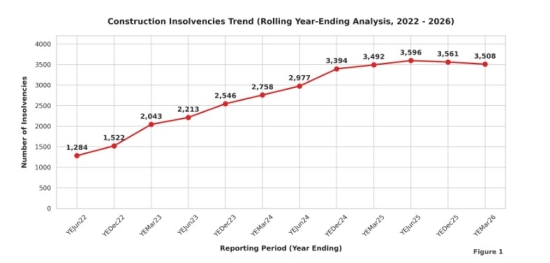
ASIC-insolvency-statistics-series-1-and-series-2-published-20-april-2026
The construction and hospitality industries reported the highest number of insolvencies over the past two years as shown in Figure 2 below, being impacted by the increased material and wage costs. The hospitality industry is also impacted by consumer issues regarding spending availability.
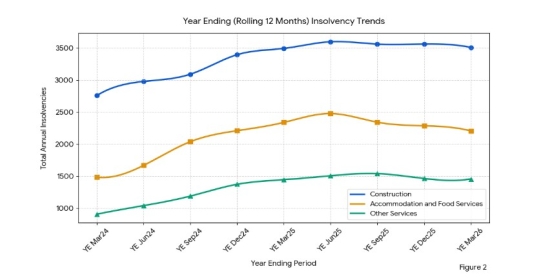
ASIC-insolvency-statistics-series-1-and-series-2-published-20-april-2026
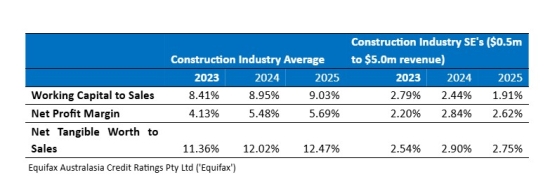
For the construction industry we see that for the Year Ended June 2025, small enterprises (SE) with less than 20 FTEs are more impacted than larger companies. Of the companies assessed by Equifax, the data as shown in Figure 3 and the table, shows that key financial indicators for the SE’s are weaker than those of the larger companies. Notably weaker are profitability (Net Profit Margin), and financial capacity measures of Working Capital to Sales and Net Tangible Worth to Sales. Unfortunately, for the Year Ended June 2025, external administrators and receivers’ reports show SE’s recording the highest number of insolvencies at 76% of total construction insolvencies.
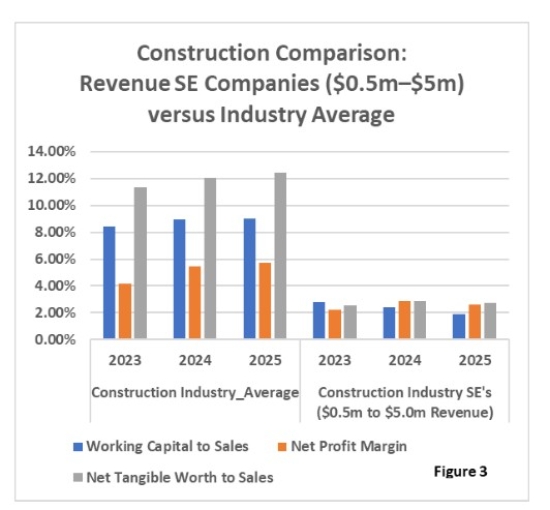
Equifax Australasia Credit Ratings Pty Ltd ('Equifax')
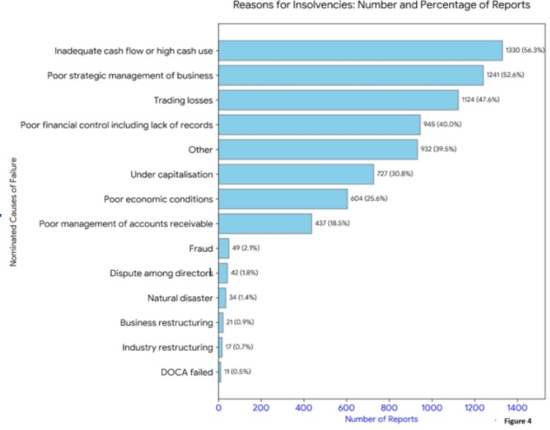
Liquidation reports record the most common reasons for companies becoming insolvent and validate Equifax’s view. The key financial reasons for the insolvencies as shown in Figure 4 were trading losses, weak liquidity, and low capitalisation. Note that there are often multiple reasons that an entity enters insolvency.
2024-2025-ASIC-insolvency-statistics-series-3-2: ASIC-Table 3.2.2.1 - Initial external administrators and receivers reports for Construction industry
The Australian construction industry appears to be facing a systemic insolvency threat. While major firms priced in initial inflation, evidence suggests many subcontractors (SEs) may not have, leaving them highly vulnerable to recent interest rate hikes and war-driven material/fuel spikes. If geopolitical tensions persist, a possible wave of SE failures may cause project delays and cost overruns, likely increasing the number of insolvencies of larger enterprises.
Highlighting this stress and compounding the pressure for the SE’s, early Equifax Commercial Insights 2026 data for 26Q1 v 25Q1, reveals a 5.6% drop in small to medium enterprises (SME) credit demand following consecutive rate hikes, alongside a 49% surge in ATO tax debt disclosures—a historical precursor to an increase in insolvencies.
In this heightened risk environment, business operators may want to consider evaluating how much risk they take on with counterparties and look at increasing their due diligence to help manage their risk exposure.
Minimise credit risk with a 360-degree view powered by Equifax next-generation commercial credit scores and counterparty and in-depth risk assessments.
Contact Equifax to learn more
This article was written by Equifax Deputy Chief Ratings Analyst, Peter Cobiac
Useful reading: The Construction Margin Squeeze Report
Latest insights: Visit our Market Pulse Hub for the latest Credit Trends, Market Data and Economic Insights
The information contained in this article is general in nature and does not constitute personal, financial, legal, or tax advice. It does not take into account your personal objectives, financial situation, or needs. Therefore, you should consider whether the information is appropriate to your circumstances before acting on it, and where appropriate, seek independent professional advice. This document contains information sourced from third parties, including the Australian Securities and Investments Commission (ASIC) and the Australian Taxation Office (ATO). Equifax has not independently verified this information and accepts no liability for any inaccuracies contained in third-party data.
Correct as of June 2026.
Copyright © 2026 Equifax Australia Information Services and Solutions Pty Ltd. All rights reserved. ABN 26 000 602 862.